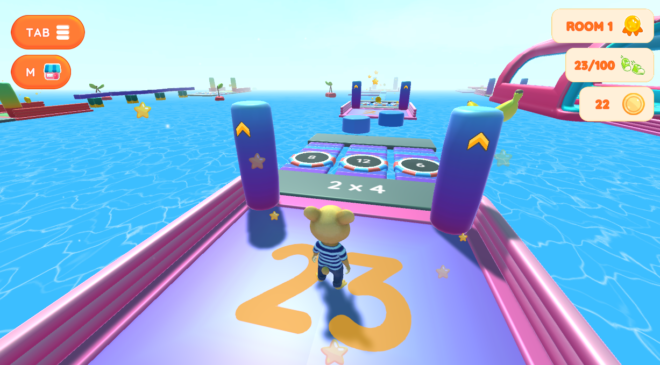
3×3 Obby is a browser obstacle-course game where you guide your character through a series of platforms, jumps, gaps, and other hazards while trying to reach the end without falling. The idea is pretty straightforward: move through the course, judge each jump carefully, avoid the obstacles, and keep going until you reach the finish. You don’t need to understand a complicated rulebook before playing, which is probably the first thing I liked about it. You can jump in, get moving, and figure out the rhythm as you go.
If you’ve played an obby before, you already know the basic feeling. You see a platform in front of you, estimate the distance, jump, land safely, and immediately start worrying about the next one. That’s basically the entire concept, but there’s a reason obstacle games like this can become surprisingly addictive. The controls may be simple, but getting through a difficult section without making a stupid mistake is another story entirely.
I learned that pretty quickly with 3×3 Obby.
At first, I wasn’t taking it particularly seriously. I looked at the opening sections and thought they seemed easy enough. I’ve played plenty of platformers, so I figured I’d cruise through the early part of the course without much trouble. And, well, that confidence lasted right up until I missed a jump that looked almost impossible to miss.
That’s the funny thing about obby games. The difficult jumps aren’t always the ones that get you.
Sometimes you fail because you rush.
Sometimes you don’t line yourself up properly.
And sometimes you simply assume your character will land somewhere it absolutely will not.
For a new player, I’d recommend slowing down during the first few sections and getting comfortable with the movement. You don’t need to sprint through every platform. In fact, moving too quickly is probably one of the easiest ways to turn a simple jump into an unnecessary fall. Take a second to look at where you’re going, position yourself properly, and then make the jump instead of immediately charging forward.
That sounds obvious, but it makes a difference.
One thing I appreciate about 3×3 Obby is that the gameplay doesn’t need a huge collection of mechanics to stay interesting. The challenge comes from the level itself and from your own ability to control the character. You’re constantly making tiny adjustments. You move slightly to the left, stop, line up your next jump, and then commit. After a while, you start developing a rhythm without even thinking about it.
That’s when the game feels best.
You stop treating every platform as an individual obstacle and start seeing the course as one continuous movement sequence.
Of course, getting to that point takes practice.
The early sections are useful because they give new players time to understand how the game responds. You can learn how far your character can jump, how quickly you move, and how much room you need before committing to a difficult landing. I’d definitely recommend using those easier areas as practice instead of treating them as something you need to rush through.
For players who have already spent time with obby games, the experience is a little different. You probably won’t need much time to understand the controls, so your attention immediately moves toward efficiency. Can you complete a section without stopping? Can you make a jump consistently? Can you find a safer route instead of relying on a risky shortcut?
That’s where I think replaying 3×3 Obby becomes more interesting.
Your first goal is simply to finish.
Your next goal is to finish without making mistakes.
After that, you start trying to improve your movement and complete sections more smoothly.
Personally, I like that kind of progression because it doesn’t require an elaborate ranking system to make me want to improve. Sometimes I just want to know that I can do something more cleanly than I did ten minutes ago.
And yes, there is a certain satisfaction in finally landing a jump that previously made you fall five times in a row.
You know the feeling. You miss it once and think, “Okay, bad timing.” Then you miss it again. Then again. By the fourth attempt, you’re convinced the platform has personally offended you. Finally, you make the jump and immediately realize it wasn’t nearly as impossible as you had convinced yourself it was.
That’s basically the obby experience in a nutshell.
I also think patience is more important here than raw reflexes. Fast reactions certainly help, but many failures happen because players don’t give themselves enough time to read the course. If you look ahead, you can often figure out what kind of movement the next section requires before you’re already standing on the edge of a platform.
For beginners, I’d suggest looking two or three obstacles ahead whenever possible. Don’t stare only at the platform you’re about to land on. While you’re moving, start thinking about the one after it. That small habit can make the entire course feel less chaotic.
Experienced players can take this even further by learning the layout and developing consistent movement patterns. Once you know where the awkward sections are, you can approach them with more confidence instead of reacting at the last second. That’s when an obstacle course starts feeling less like a test of luck and more like something you can actually master.
The presentation also suits the concept. 3×3 Obby doesn’t need to bury the player under menus, complicated objectives, or distracting systems. The important thing is the course in front of you, and that’s where your attention naturally stays. I generally prefer this approach in browser games because it lets me get into the actual gameplay almost immediately.
There is, however, one potential issue with this kind of game: repetition can become a problem if you’re looking for constant novelty. Obby games depend heavily on good course design, and once you’ve memorized every section, some of the original tension disappears. That’s why additional stages, increasingly creative obstacles, or new challenges would be valuable for keeping experienced players interested.
Still, I wouldn’t judge 3×3 Obby purely by how much content it throws at you. The quality of the actual obstacle experience matters more. If the jumps are enjoyable and the controls feel predictable, even a relatively simple course can keep you occupied longer than expected.
And that’s probably the biggest surprise I had with the game.
I didn’t expect to spend much time thinking about individual jumps. Yet after playing for a while, I found myself trying to improve little things. Better positioning. Cleaner landings. Less hesitation. Fewer unnecessary falls.
For a beginner, I’d say the best advice is simple: don’t rush, learn the movement, and don’t get frustrated when you fail the same jump repeatedly. You’re supposed to make mistakes. That’s how these games teach you.
For experienced players, I’d recommend treating the course almost like a time trial, even if you aren’t officially racing anyone. Try to make your movement smoother. See how consistently you can clear the harder sections. Once you know the layout, challenge yourself to make fewer mistakes.
Overall, 3×3 Obby is the kind of browser game that doesn’t need to pretend to be something bigger than it is. It gives you an obstacle course, puts your movement skills to the test, and lets you decide how seriously you want to take the challenge.
I went in expecting a quick platforming distraction.
Instead, I ended up replaying sections just because I knew I could do them better.
Honestly, that’s a pretty good sign. When a game makes a simple idea feel satisfying enough that you willingly try the same challenge again, it has already done something right.